There is one room in your house that greets every single person who comes to your door, sets the initial emotional temperature for everyone who lives there, and quietly decides how much of the outside world makes it all the way inside. And in most homes, it’s frequently the room that gets minimal consideration.
The entryway is frequently an afterthought in the typical floor plan – a few square feet between the door and the rest of your life, a place to kick off shoes and drop the mail on the way to somewhere that feels more important. But the entry is doing more invisible work than almost any other room in the house. It is the threshold to your home and it matters more than we give them credit for.
This month at the studio we are thinking about the home as a gathering house – a place built to welcome people in and, just as importantly, built to protect the people who live inside it. The entry is where both of those jobs begin. So let’s start at the door!
The Psychology of Arrival
Your nervous system is reading the room before your conscious mind catches up. The moment you step through your own front door, your body is taking inventory: Is it bright or dim? Cluttered or clear? Is there somewhere to set this bag down, or am I already negotiating an obstacle course in the first six feet of my home?
Isn’t our wiring fascinating? We are constantly, pre-consciously scanning our environments for cues of safety and order, and the entry is the first cue we get. A calm, legible entry tells the body: you are home, you can put it down now. A chaotic one keeps the stress response humming, and you are still bracing for danger before you have even taken off your coat.
I spent years as a first responder (law enforcement and EMS) before I designed a single room, and that work taught me something I have never been able to un-see: environments regulate us or they dysregulate us, and they do it whether we are paying attention or not. The most powerful design choices are often the ones that work below the level of notice. A good entry is one of them. It does its’ job before you know it is working!

The Biophilic Entry
Biophilic design — the practice of building our innate need for nature into the spaces we live in — has a great deal to offer in the rooms we tend to neglect. The entry is a perfect candidate, because it is the transition zone between the outside world and your home. Bring a little of the outside in, intentionally, and the transition softens.
Natural light first. If your entry has a sidelight, a transom, or a nearby window, protect it. Don’t block it with a too-tall piece of furniture or a heavy window treatment. Light is the single most regulating element you can offer a body walking in from a long day.
Something living. One or two plants in the entry soften the architecture, signal life and care, and bring a little of the natural world into a space that often feels purely functional. I recommend choosing varieties that earn their keep in lower light and forgive a missed watering —ZZ plants, snake plants, and pothos are all easy to grow. These also happen to be among the plants that help with your air quality as well. (If this topic interests you, my expertise was featured recently in Mansion Global and you can read that here.)
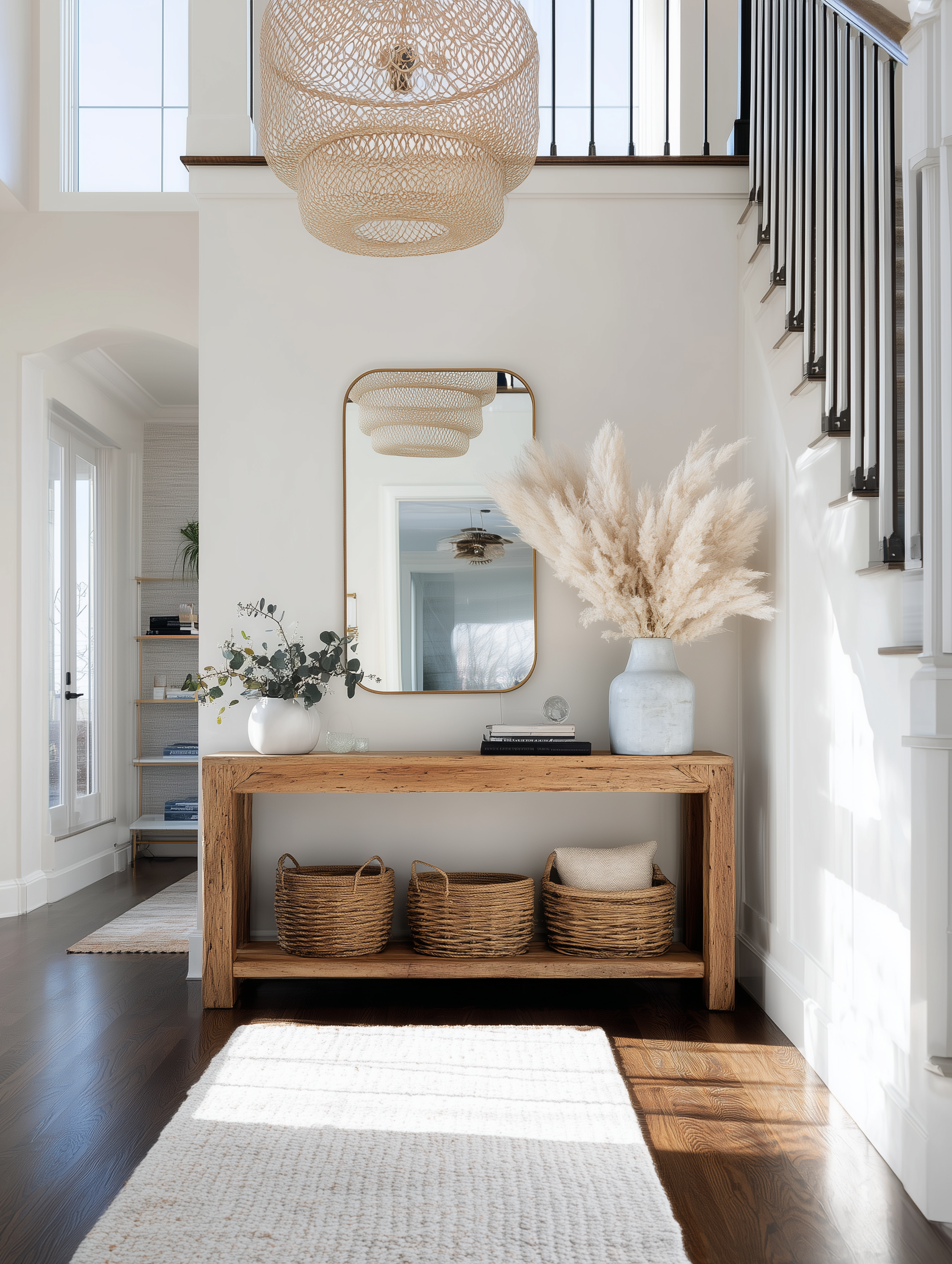
Texture and sound. Try adding something to your entry that invites you to touch it. A natural-fiber runner underfoot or a woven basket for example – these are the sensory details that elevate a simple entryway. Texture invites touch, and touch grounds us.
The Healthy Entry: Where the Outside Stays Outside
One of the most important parts of entry way design is helping to ensure the health of your home. Your entry is the primary filter between the outdoor environment and your indoor air — and indoor air is, for most of us, considerably more polluted than the air outside. A thoughtfully designed entry is one of the simplest, highest-impact things you can do for the health of your home.
A real shoe-removal zone
Shoes track in more than dirt: pesticides, lawn chemicals, traffic residue, allergens, and a long list of things you would never knowingly spread across the floors your children play on. A dedicated, comfortable place to take shoes off at the door — a bench, a basket, a tray — is one of the highest-leverage healthy-home habits there are. And when you are asking visitors to adhere to your show policy, a lot depends on how easy you make it for them!

A layered entry mat system
Most homes have one flimsy mat doing the work of three. The system that actually works is layered: a coarse scraper mat outside to knock off debris, and an absorbent, washable mat inside to catch fine dust, moisture, pollen, and whatever else tried to hitchhike inside.
A drop spot that contains the chaos
Keys, mail, bags, sunglasses, the day’s odds and ends — give it all a home within arm’s reach of the door! A tray, a bowl, a wall of hooks, a slim console with a drawer – whatever system works best for you is the right one. When the entry has a designated catch-all, you’re going to have fewer instances of “honey have you seen my keys,” and your nervous system gets the legible, ordered first impression it is craving. If indoor air quality is something you find yourself thinking about — and after the last few years, more of us are — the entry is where the strategy starts.

The Southern Entry
And I would be betraying my southern roots if we didn’t talk briefly about the particular genius to the Southern entry that the rest of the design world is slowly rediscovering! It is that the welcome begins before the threshold! The porch, the screen door, the ferns hanging from the rafters, the rocking chairs angled toward the street — these are not decoration. They are an architecture of hospitality, a series of gentle thresholds that ease a guest from the public world into the private one.
A screen door is a profoundly intelligent piece of design: it lets the breeze and the sound of the neighborhood in while keeping the bugs out, and it announces a visitor with a sound every Southern child knows by heart. A deep porch creates a shaded, in-between room — not quite outside, not yet inside — where you can greet someone, sit a while, let the day downshift before you ever open the inner door.
If you are lucky enough to have a porch, design it like the room it is. And if you are working with a more modern entry, you can still borrow the principle: build in a moment of pause before the threshold. A bench just outside. A planter that signals care. A light that says, we were expecting you.

A Note for Mother’s Day
With Mother’s Day this weekend, it is worth saying: the woman who walks in your door first — the one who has been quietly noticing the dropped shoes and the chaotic catch-all for years — might appreciate something for the room that greets her every single day. A few ideas that fit the spirit of an intentional entry:
- A beautiful tray to corral the daily drop — something in brass, marble, or hand-thrown ceramic that turns the catch-all into a small still life.
- A candle that smells like welcome home — a green tomato-leaf, a fig, a fresh herbal note. Scent is memory, and the entry is where the home’s scent story begins.
- A framed print at eye level — the first piece of art a guest sees, and a daily gift to the person who lives there.
- An entry plant in a vessel she would never buy for herself — living, generous, a little bit indulgent.
Start at the Door
You do not have to renovate to design a better entry. Most of what makes an entry work — a place to sit, a place to drop items, a layered mat, a living thing, protected light, contained chaos — is a matter of intention, not budget. Start at the door, and the whole house feels different.
If you want help seeing your own entry with fresh eyes, the 30-Minute Home Reset Guide is the easiest place to begin — it will walk you through the first, highest-impact moves room by room. And when you are ready to think through your whole home with someone who looks at it through the lens of both beauty and health, I would love to talk. You can book a free 30-minute Discovery Call anytime to discuss your home and the projects you’d like to accomplish.
Keep Reading on a Healthier Home:


homes