Publication: Country Living
Article Title: Love the Nantucket Look? Start Hunting for These Thrift-Store Finds
Publication Date: July 22, 2026
Author: Sarah Lyon
There are few things I enjoy more in the interior design industry than watching the ideas I care about most — collected interiors, natural materials, and sustainability (to name a few) — make their way into a wider conversation. So I was honored when Country Living asked for my perspective on capturing the Nantucket look through vintage and secondhand finds. It’s my first feature with them, a publication I’ve long admired, and the subject sits close to the center of how I design.
To me, an authentic Nantucket look has very little to do with nautical motifs. It is the look of a home shaped by generations of use. And that is precisely why shopping secondhand isn’t the budget version of the style; it’s the more honest one! The patina and craftsmanship of an older piece are nearly impossible to reproduce in anything new, and that lived-in quality is what gives the look substance. Here are my tips and methods for finding the perfect pieces!
Begin with woven seating
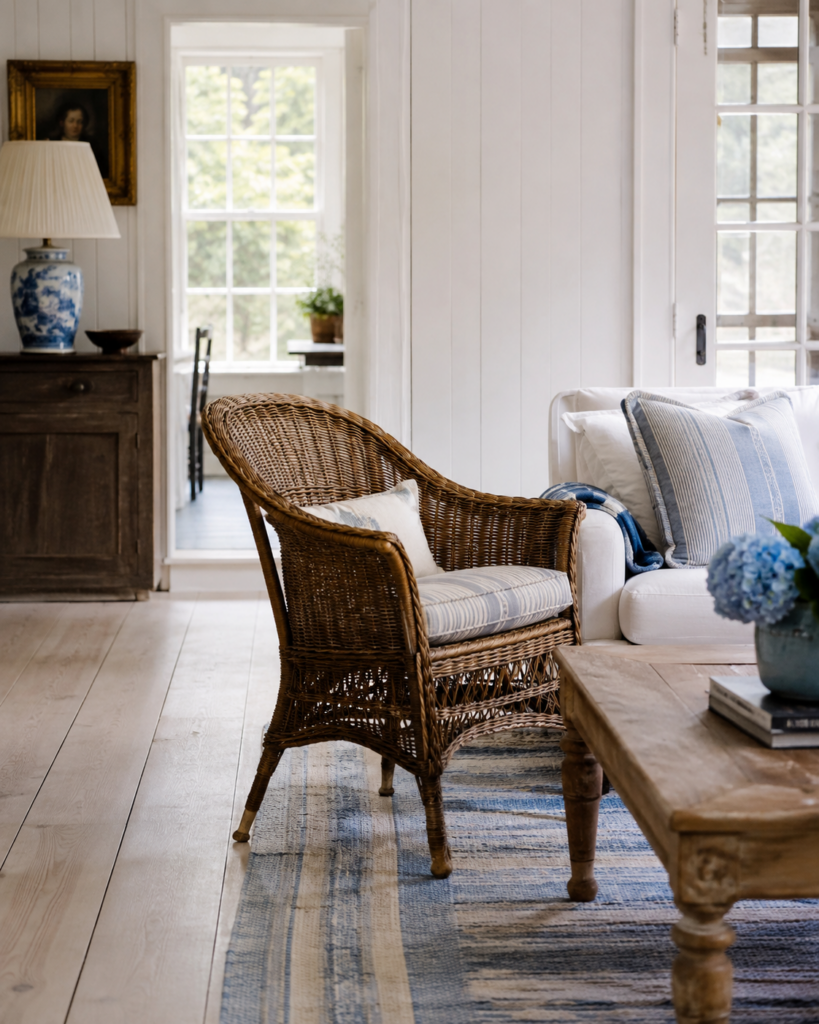
My favorite place to start is with woven materials — vintage wicker, rattan, and rush-seat chairs catch my eye every time! These materials do a beautiful job of adding a collected, lived-in quality into a room quickly. Even one well-chosen piece does a remarkable amount of work: a pair of rush-seat chairs drawn up to a table, or a single rattan chair beside a window, and the room begins to read coastal without a single overt reference.
Layer in case goods with history
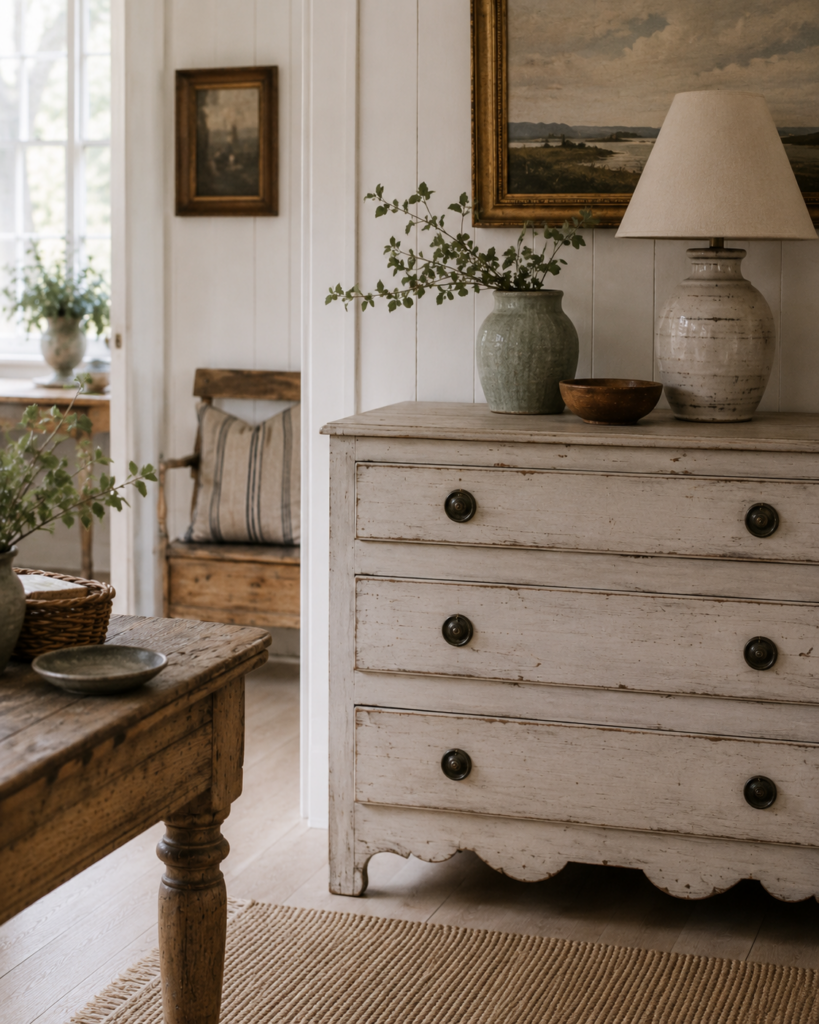
From there, I look for the pieces that give a room its bones and its backstory — painted chests, old wooden benches, antique pine tables. Their appeal lies in the visible record of use: a softly worn edge, a surface gone smooth under decades of hands. And when the bones are good but the finish is wrong, a little bit of restoration can go a long way. For example – an antique chest that has been sanded and repainted, takes on a beautiful seaside patina.
Collect the natural accessories
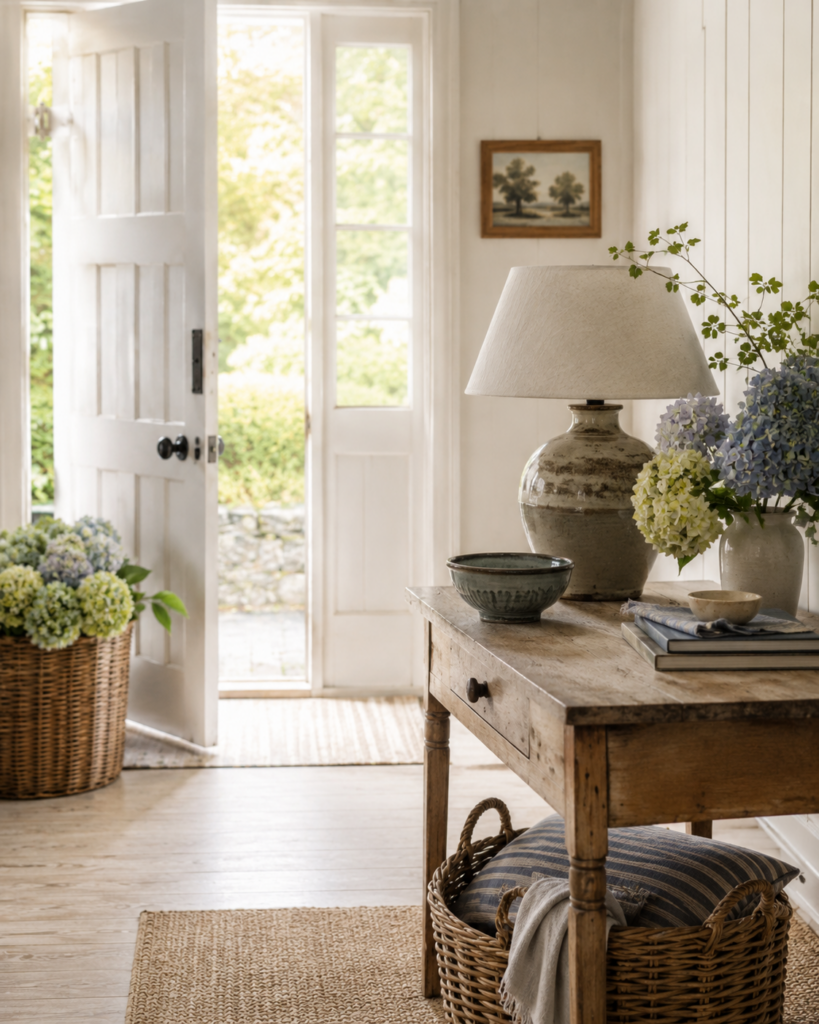
Accessories are the layer I most love to hunt for secondhand — woven baskets, ceramic lamps, ironstone. Baskets especially are worth the search, and you’ll usually pay a fraction of what they’d cost new. A few gathered on a wall, a ceramic lamp on a chest, a stack of ironstone, a pitcher of whatever’s blooming that week — none of it is much on its own, but together it’s what makes a room feel like someone actually lives there.
Let texture lead, over color
This is the idea I kept coming back to in the Country Living piece: “texture is almost more important than color in a Nantucket-inspired room.” A restrained palette gets so much more interesting the moment you layer weathered wood, rumpled linen, woven fiber, aged metal, and handmade ceramic. Linen, cotton, ticking stripe, rush, wicker, jute, stoneware, unlacquered brass — it’s the variation in texture, more than color, that keeps a neutral coastal room from falling flat. It’s also why I shop with my hands as much as my eyes; I touch nearly everything, and I tell my clients to do the same.
Draw the palette from the landscape
When it comes to color, the coastal palettes that actually convince are the ones that look like they were pulled from the landscape outside the window. Mine tends toward oyster white, warm sand, foggy gray, faded indigo, soft slate blue, weathered wood, and muted sea-glass green. I keep everything close to that natural range and let pattern, rather than bright color, do the work.
Know what to look for — and what to pass by
The most common misstep is chasing pieces that still look showroom-new. You’re far better off doing the opposite: look for a softly worn finish, aged brass, faded fabric, wood marked by time. That wear is the point. The one caveat is that there’s a real difference between authentic wear and actual damage — you want sound construction and honest age, not something unstable or falling apart. Rustic is a finish; it’s not an excuse for a piece that doesn’t hold together.
Resist the pull toward the literal
It’s easy, with a coastal look, to drift toward the literal — anchors, shells, signage, matched sets of blue-and-white — and I’d like to gently steer you away from it. As I told Country Living, a single vintage maritime painting or framed map can be lovely, but “an entire room of literal nautical references can quickly feel more like a themed rental than a home with history.” Let the coast come through instead in the palette, the materials, the craftsmanship, and the small stories a room holds. That’s the difference between a room that looks like Nantucket and one that actually feels like it.
Read the full feature in Country Living →
Love finding the perfect vintage or thrifted piece? Check out these posts!
Secondhand Garden Finds: Thrifted Treasures for Southern Gardens – Southern Living asked for my ideas on incorporating thrifted finds into the garden. This was an incredibly fun topic to work on and its so popular they showcased it again this year! (Originally published in 2025).
A home that feels collected, calm, and quietly coastal
The magic of a collected home isn’t in any single find — it’s in how it all comes together. Bringing those pieces into one intentional, story-rich space is the work I love most at The Intentional Design Studio, and I’d be so glad to help you shape a home that tells your story. Book a discovery call →
Catherine Shuman is the founder and principal designer of The Intentional Design Studio, a biophilic, wellness-focused interior design practice in Athens, Georgia. With a background in first response and formal training in building biology and neuroaesthetics, she designs homes that support the nervous system as much as the eye. Her design commentary has appeared in publications such as: Country Living, Southern Living, Elle Decor, Martha Stewart, Homes & Gardens, and The Spruce.