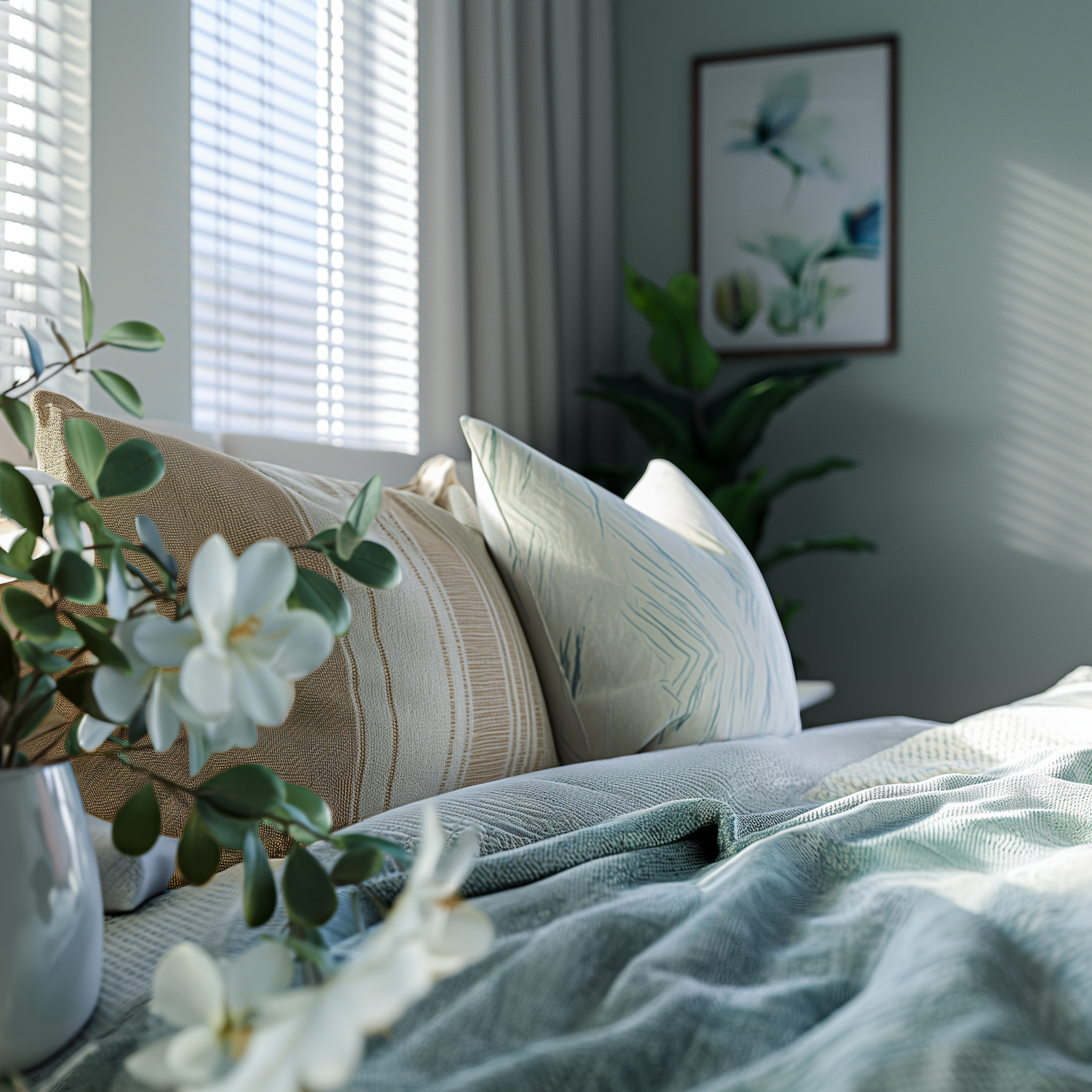
Yes. Your bedroom layout directly affects how well you sleep — sometimes more than your mattress, your sheets, or your screen-time habits. When your bed faces the wrong direction, your room is cluttered, or natural light can’t reach you, your nervous system reads the space as unsafe and stays in a low-grade threat response. Deep, restorative sleep becomes nearly impossible, no matter how tired you are.
The good news is that with a few intentional changes – starting with where your bed sits – you can shift your bedroom from stimulating to truly restful.
I was recently featured in The Spruce sharing on this topic. This is the deeper version of that conversation. You can read The Spruce article here.
Why your bedroom layout matters more than you think
Most sleep advice focuses on what you do before bed: dim the screens, skip the late coffee, take the magnesium. All solid advice. But none of it addresses the environment you’re actually trying to fall asleep in.
Your bedroom, at its most basic purpose, is for one thing: a place to rest and recharge. For your brain to let that happen, it has to feel safe. And your brain doesn’t decide a room is safe based on how pretty it looks (although we wouldn’t dream of designing something that wasn’t stunning) — it decides based on signals it’s been reading for hundreds of thousands of years. Can I see what’s coming through the door? Is the space visually calm or busy? Is there a clear sense of order? Do I have anything related to nature in here?
When those signals say “not safe,” your nervous system stays subtly activated. You fall asleep slower, wake more easily, and spend less time in the deep sleep stages that actually restore you. And you probably don’t realize the room is the reason.
This is the territory of neuroaesthetics — the study of how design affects the brain and nervous system — and it’s the lens I bring to every bedroom I work on.
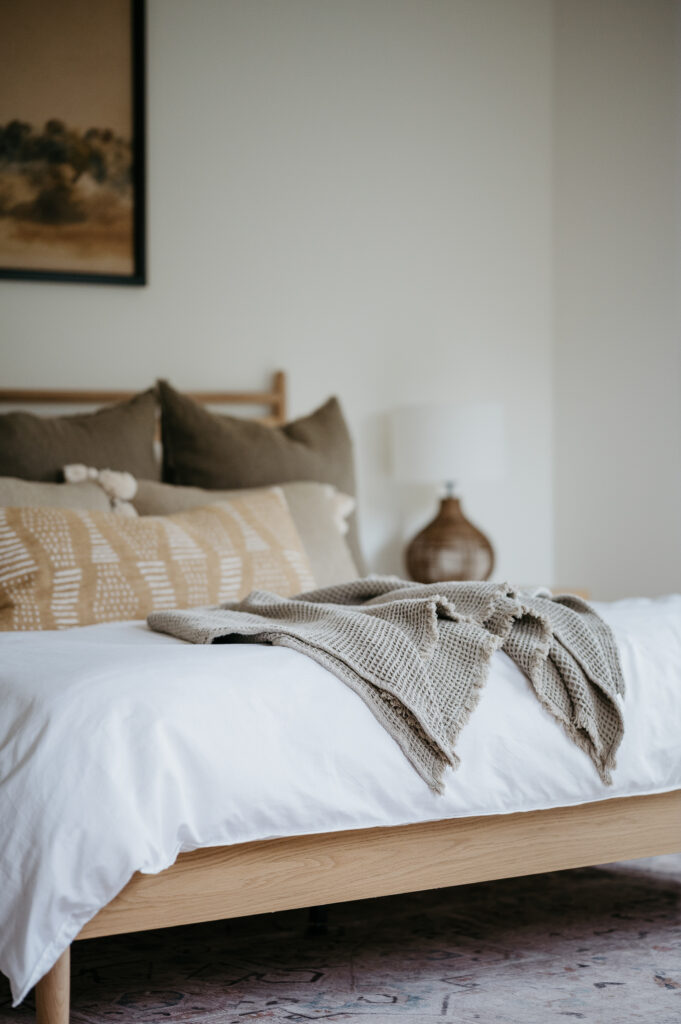
The single most impactful change: reposition your bed
If you only do one thing after reading this, do this.
Move your bed so you can see the door from where you sleep, without being directly in line with it. This is known as the command position, and it’s not a woo-woo concept — it’s rooted in ancestral threat assessment. For most of human history, the ability to see (and therefore react to) what was coming before it reached you was the difference between waking up and not. Your brain still runs that program every night.
A bed with its back to the door, or tucked where you can’t see the entry, keeps your nervous system on low alert. A bed positioned with a clear sight line — but not perfectly aligned with the doorway — tells your brain: I can see what’s coming. I’m safe. I can power down.
In smaller bedrooms, this can take some creative furniture rearranging. It’s worth it.
Four more adjustments that change how your bedroom feels
1. Balance the weight of the room
Look at your bedroom from the doorway. Does one side feel heavier than the other — a massive dresser on the left with nothing to counterbalance it on the right? Our brains love symmetry. It signals order, balance, and calm. When a room is visually lopsided, it registers as subtly wrong, even if you can’t name why.
Asymmetry done well is beautiful. Asymmetry so drastic it feels like literal weight is exhausting to sleep next to. Matching nightstands, paired lamps, or simply adjusting what hangs on each wall can rebalance a space fast.
2. Layer your lighting
Overhead lights are the enemy of a restful bedroom. They’re bright, they’re flat, and they mimic the daylight signals that keep your body alert.
Add lamps and sconces at eye level and below. Use warm bulbs (2700K or lower). In the hour before bed, only the low lamps should be on. This isn’t just ambiance — dim, warm light supports your body’s natural melatonin production, which is the biochemical signal that it’s time to sleep.
3. Remove every non-sleep function from the room
This is the mistake I see most often. A desk in the corner. A pile of laundry. Workout equipment. A stack of paperwork that was supposed to get filed three weeks ago. When your bedroom doubles as your office, your gym, and your storage unit, your brain stops associating the space with rest — because it isn’t one.
Worse, all those objects are visual information your brain has to process. Instead of downshifting, it stays in processing mode.
If you can, move the desk out entirely. If you can’t, put it against a wall where you can’t see it from bed, clear it off, and close the laptop. Store work materials behind closed doors. Your brain needs to walk into that room and know exactly what the room is for.
4. Add something living
One of the easiest biophilic design moves: introduce a natural element. A plant. A cotton throw. A wool blanket. A small stone on the nightstand. Wood grain you can actually see and touch.
These aren’t decorative afterthoughts. Natural materials and living elements cue the nervous system toward calm in a way synthetic materials can’t replicate. It’s a small signal, but it stacks up with the other changes you’ve made.
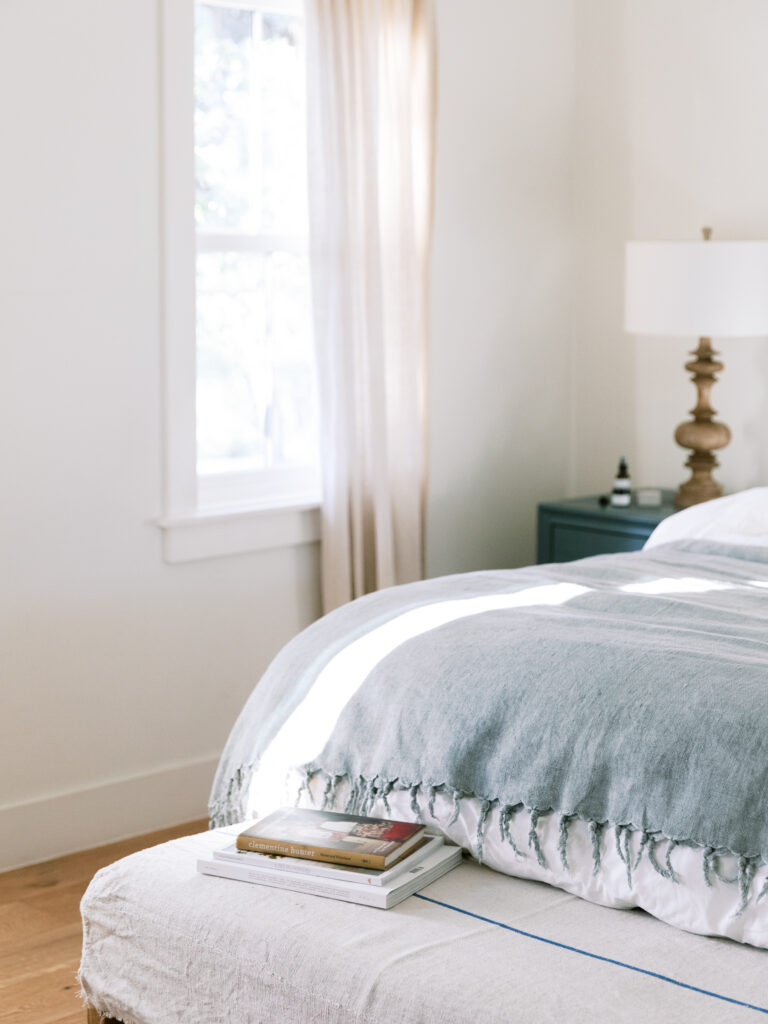
Five things to avoid in a sleep-supportive bedroom
And now let’s get into what you should avoid – these are the habits and choices that undo the work of a good layout:
- Clutter, visual or physical. Open shelving with lots of small objects counts.
- Electronics with lights or sound. Charging phones, blinking routers, televisions on standby.
- High-contrast, high-saturation color. Opt for muted, grounded tones.
- A warm room. Cool, well-ventilated spaces support deeper sleep.
- All synthetic materials. Polyester bedding, plastic everything, no plants — the room reads as sterile to your nervous system.
How to get started:
You don’t need to redesign your whole bedroom this weekend. Start with one change:
- Can you see the door from your bed? If not, figure out how to move the bed.
- Can you name three work-related objects in your room right now? Remove or hide them.
- Is your only light source overhead? Add a lamp on each nightstand.
That’s enough to start shifting how the room feels — and how you sleep in it.
The bigger picture
Your home is not a neutral backdrop. Every room is either supporting your nervous system or taxing it, and the bedroom is where that impact is clearest because you spend a third of your life in it with your defenses down.
Designing for rest isn’t a luxury. It’s one of the most practical, measurable things a well-designed home can give you.
Free Download: The 30-Minute Home Reset Guide
Clutter is one of the biggest sleep disruptors hiding in plain sight — and it’s rarely about “being messy.” It’s about rooms that have too many jobs and too much visual information for your nervous system to settle.
The 30-Minute Home Reset Guide walks you through the exact process I use with clients to quickly restore calm to any room — including the bedroom. It’s the fastest way to start applying everything in this post.
Download the 30-Minute Home Reset Guide →
Want to learn more? I highly recommend these posts!
Want to learn more about the friction points in your home and how to resolve them? Check out our blog post on The Friction Points in Your Home.
Interested in learning more about natural light and how it affects you? Check out our blog post on How Natural Light Affects Your Mood, Sleep, and Energy — And What to Do About It in Your Home.
And lastly – I was featured in another Spruce article on Bedroom Features That Sabotage Sleep (and How to Fix Them (this one is my thoughts and a link to the article) or you can go directly to the article here.

Frequently Asked Questions
Does bedroom layout really affect sleep quality? Yes. Bedroom layout affects sleep quality because your nervous system continually reads your environment for safety signals — even while you’re asleep. Layouts that position your bed out of sight from the door, overload the space with visual clutter, or rely on harsh overhead lighting keep your body in a state of low-grade alertness that prevents deep, restorative sleep.
What is the command position for a bed? The command position places your bed so you have a clear line of sight to the bedroom door without being directly in line with it. This position satisfies an ancestral need to see potential threats before they reach you, which allows your nervous system to fully relax. It is widely considered the single most impactful layout change for improving sleep.
What is the biggest bedroom layout mistake that hurts sleep? Treating your bedroom as a multipurpose room. When your bedroom also functions as your office, gym, or storage area, your brain stops associating the space with rest and struggles to transition into sleep mode. Removing or hiding non-sleep items is one of the fastest improvements you can make.
How does lighting affect bedroom layout and sleep? Bright overhead lighting suppresses melatonin production and signals your body to stay alert. A layout that includes multiple lower light sources — table lamps, wall sconces, bedside lights — allows you to dim the room gradually in the evening and supports your body’s natural transition to sleep.
Can small changes actually improve sleep, or do I need to redesign the whole bedroom? Small changes can make a significant difference. Repositioning your bed, removing work materials, adding a lamp, and introducing a natural element like a plant or cotton blanket are all low-cost adjustments that meaningfully shift how your nervous system experiences the room.
Catherine Shuman is the founder of The Intentional Design Studio, a wellness based interior design practice based in Athens, Georgia. She specializes in nervous system design and neuroaesthetics — helping clients build homes that support wellbeing from the inside out.


homes