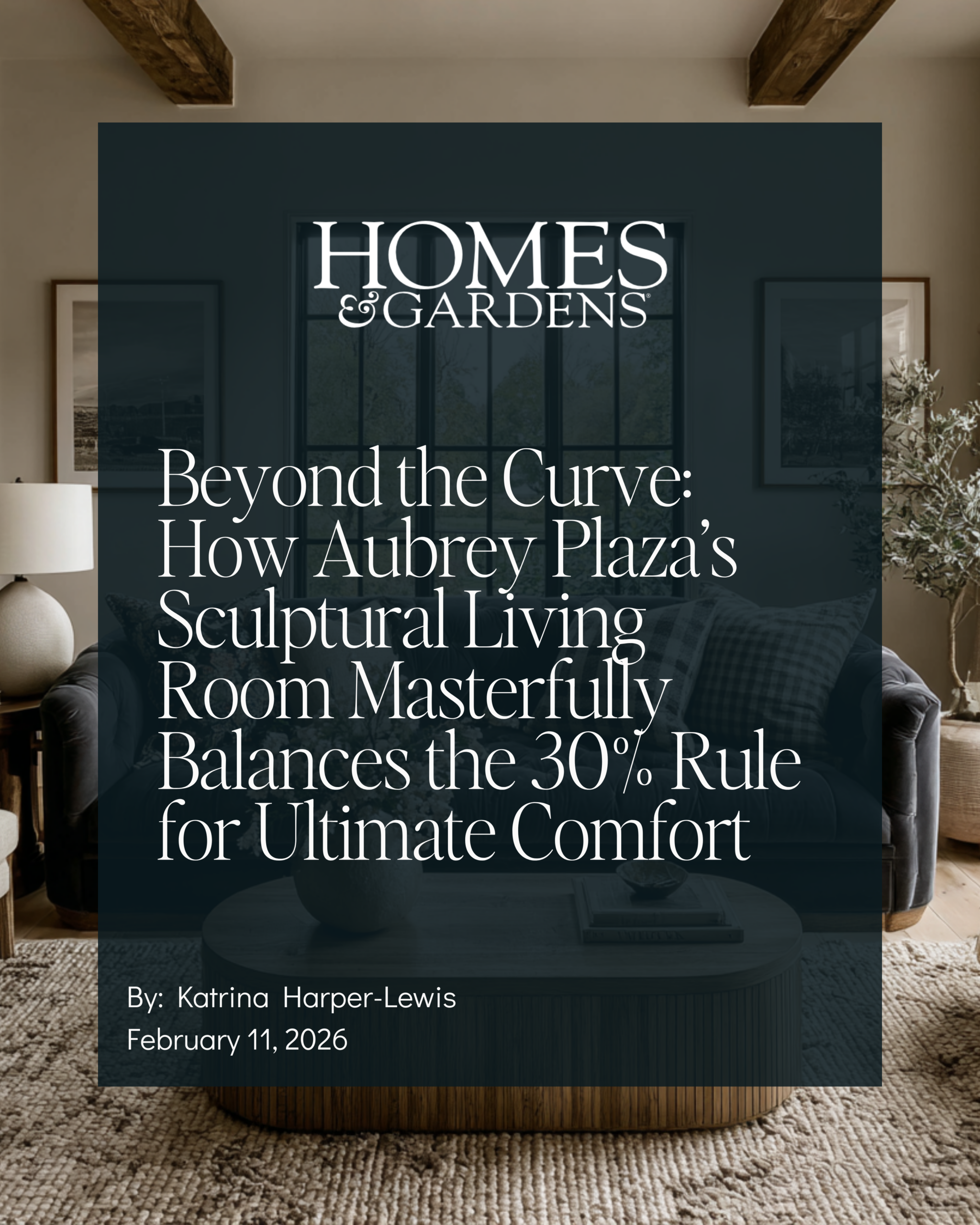
We were excited to be featured in Homes & Gardens for their piece on Aubrey Plaza’s beautifully curved living room! Being asked to explain the wellness benefits of curved architecture and furniture was perfect—this is where design psychology meets nervous system science.
Publication: Homes & Gardens
Article Title: Aubrey Plaza’s Curved Living Room
Publication Date: February 11, 2026
Author: Katrina Harper-Lewis
Homes & Gardens explored Aubrey Plaza’s stunning living room featuring curved architectural elements and rounded furniture, asking designers to explain why curves create such inviting, comfortable spaces. The article examines both the aesthetic appeal and the biological response to organic shapes in our homes.
Why Curves Feel So Good: The Nervous System Connection
When Homes & Gardens asked about the impact of curves in living spaces, here’s the science-backed perspective I shared:
I specialize in wellness-focused spaces, and curves have a surprisingly large impact on our nervous system that many people have no idea about! Our nervous systems find curves calming because they mimic the natural organic shapes we find in nature. When we incorporate items like rounded mirrors, sculptural vases, or curved furniture in our living rooms, we are softening the hard edges commonly found in modern architecture and making the room feel more comfortable.
Clients often tell me their space feels “lighter” or “more open” after we introduce softer lines, even when nothing else has changed. That’s the magic of curves!
The Architectural Advantage
The same principle applies when the curves are part of the existing architecture—whether through arched doorways, rounded windows, or barrel-vaulted ceilings, our minds and bodies respond positively to those curves! I believe that everyone who has seen a beautiful Instagram photo showcasing an arched doorway has immediately wondered about the feasibility of getting a few of those into their own homes!
Curves in the architecture set the tone for the entire room and generate a sense of flow and movement. They guide the eye naturally through the space and eliminate the harsh visual “stops” that sharp corners create.
How to Incorporate Curves Without Overwhelming Your Space
Start With One Statement Piece
The easiest way to embrace curves without overwhelming the room is through layering. Start with one statement piece—maybe a pair of kidney-shaped accent chairs or a curved sofa—and then support it with smaller curved accessories like round side tables, a sculptural coffee table, or sculptural table lamps.
The 30/70 Rule
The key is balance—you want to create visual rhythm, not a theme park! I tell clients to aim for a mix where approximately 30% of the room’s silhouettes have curves and the rest provide support through straight lines.
This creates enough softness to register with your nervous system while maintaining structure and grounding. Too many curves can feel disorienting; too few and you lose the calming benefit.
Layer Thoughtfully
When you’re working with existing architectural curves (like Aubrey Plaza’s space), echo them in your furnishings and accessories:
Furniture Layer:
- Curved sofa or rounded accent chairs
- Kidney-shaped ottomans or poufs
- Oval or round coffee tables
Accessories Layer:
- Round mirrors (especially above mantels or consoles)
- Sculptural ceramic vases and vessels
- Curved table lamps or pendant lights
- Round or oval trays
Textile Layer:
- Circular or oval rugs
- Rounded throw pillows
- Draped curtains (the natural curve of fabric)
The Psychology Behind the Preference
Why do curves feel better?
Evolutionary Response: Sharp edges and angles signal potential danger to our primitive brain (think: cliffs, weapons, predators). Curves signal safety—they’re the shapes of nests, hills, protective caves, and natural landscapes.
Visual Processing: Our eyes follow curves naturally and smoothly, while sharp angles create abrupt visual stops. This continuous flow is less taxing on our visual system.
Biophilic Design: Curves connect us to nature. Trees, flowers, water, clouds—natural forms are overwhelmingly curved. When our homes echo these shapes, we feel more grounded and calm.
Reduced Stress Response: Research shows that viewing angular, harsh environments activates the amygdala (our fear center). Curved environments reduce this activation, literally lowering our stress response.
Celebrity Homes Getting It Right
Aubrey Plaza’s curved living room is a perfect example of this principle in action. The architectural curves create the foundation, and the furnishings echo and support that organic aesthetic. The result? A space that photographs beautifully and feels genuinely comfortable to inhabit—which is the ultimate goal.
When celebrities invest in curved architecture and furniture, they’re not just following trends—they’re (knowingly or not) creating environments that support their wellbeing. Given the high-stress nature of their work, having a home that actively calms the nervous system isn’t a luxury; it’s essential.
Why This Approach Matters
At The Intentional Design Studio, we design with the understanding that every shape either supports relaxation or creates subtle stress. Incorporating curves isn’t about following a trend—it’s about creating spaces where your body can genuinely rest.
When you walk into a room with thoughtful curves, your shoulders drop, your breathing deepens, and your nervous system registers “safe.” That unconscious response is what transforms a beautiful room into a restorative sanctuary.
We’re so grateful to Homes & Gardens for the opportunity to explain the science behind this beautiful design choice!
Read the full article on Homes & Gardens →
Curious about more furniture trends for 2026? You can read our feature in Elle Decor here (and learn about what we have termed Biophilic Maximalism!
Curious to see what else we’ve been featured in? Explore our full collection of press mentions and expert insights on our Press Page.
Ready to create a home that supports how you live and feel?
Our complimentary discovery call is the first step—no pressure, no decisions—just a chance to share more about your project and see if we’re the right fit. Click here to inquire and take the first step toward a beautifully intentional home.
📍 Proudly serving Athens, Georgia, Oconee County, Georgia and surrounding communities throughout Northeast Georgia and beyond
💌 Book a complimentary call with us to discuss your project!